How Does HyperFlow AI Lower the Barrier to AI Service Development?
HyperFlow AI transforms complex AI development processes into visual workflows, enabling anyone to design, test, and deploy AI chatbots, AI agents, and workflow automation services regardless of their technical background. HyperFlow AI’s core direction is to make AI not just a technology for specialists, but a practical work tool that entrepreneurs, educators, small teams, and business professionals can all use.
HyperFlow AI at a Glance
HyperFlow AI is an AI workflow platform built to lower the barrier to AI service development.
Traditional AI development has been difficult for many organizations to access due to complex coding, high learning costs, and dependence on specialized talent.
HyperFlow AI provides a visual flow-based interface that allows users to directly design and operate AI chatbots, AI agents, and workflow automation processes.
HyperFlow AI’s core values are inclusiveness, creativity, transparency, community, and fast impact.
Based on the belief that technology should evolve around people, HyperFlow AI continues to expand as a platform that enables more people to use AI.
Why Is AI Service Development Still Difficult?
AI is already creating new possibilities across many industries and work areas. Business automation, content creation, education, customer support, and data analysis are just some of the areas where AI can be applied.
However, applying AI to actual work is still not easy. Many organizations want to use AI but struggle with complex coding, model integration, data processing, workflow design, and deployment environment setup.
Large enterprises with specialized AI teams can quickly experiment with and adopt AI services. In contrast, small and medium-sized businesses, educators, individual creators, and small teams often cannot use AI at the same speed. This difference goes beyond a simple technology gap and leads to a broader issue where the opportunities created by AI are concentrated among only certain organizations and experts.
The Limitations of Traditional AI Development
Traditional AI development methods are powerful, but they are not open to every user. To build an AI service, users typically need to understand models, connect APIs, process data, test results, and manage deployment.
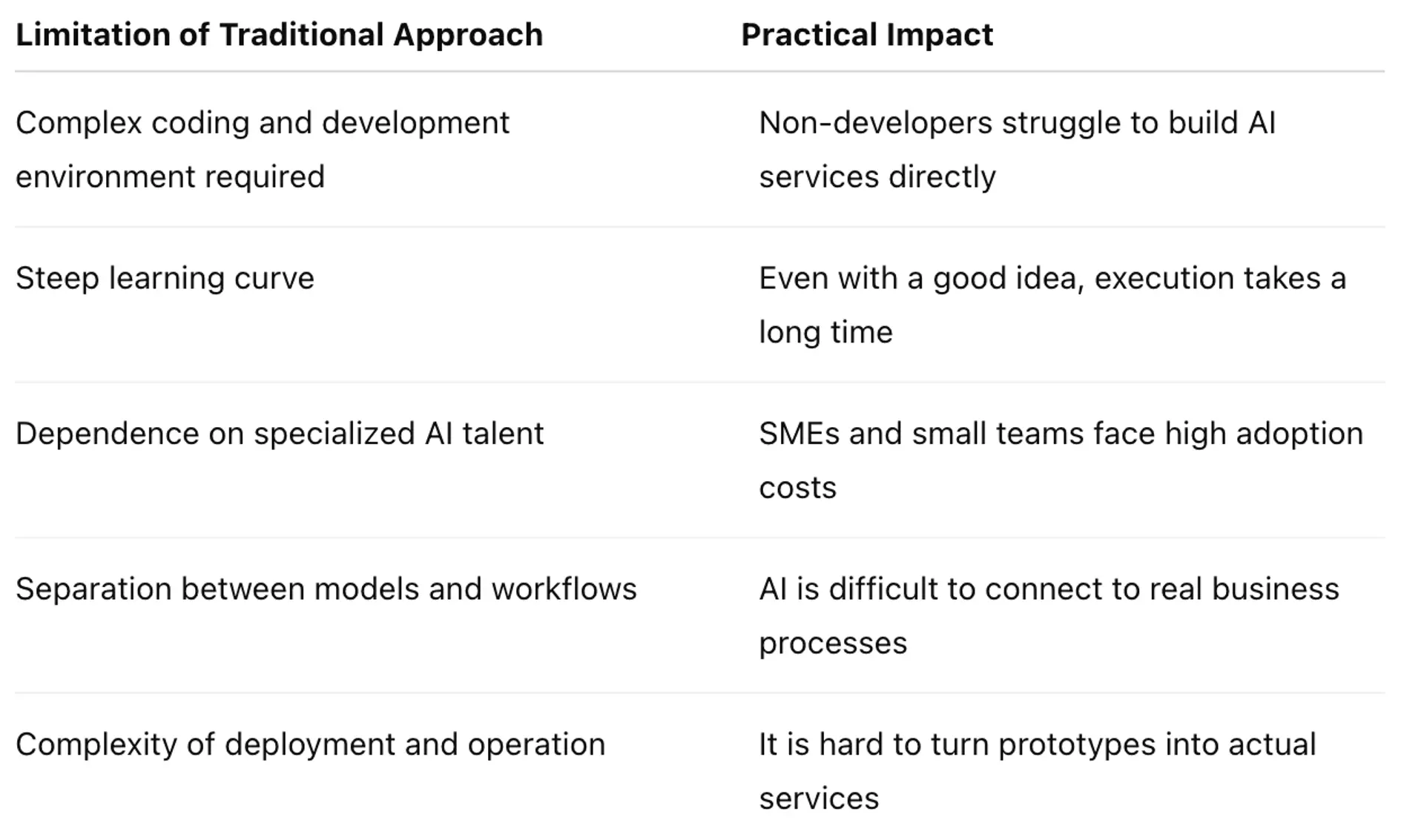
As a result, for many people, AI has remained a technology that must be handed over to experts rather than something they can build directly.
How Are n8n, Dify, Flowise, LangChain, and HyperFlow AI Different?
There are many tools that support AI service development. n8n is strong in workflow automation and service integration, while Dify supports LLM apps, RAG pipelines, and agent workflows. Flowise and Langflow are strong in visually building LLM flows, and LangChain and LangGraph are closer to developer-focused frameworks for building AI applications and agent workflows.
Within this AI workflow ecosystem, HyperFlow AI focuses on connecting AI chatbots, RAG-based knowledge search, AI agents, workflow automation, deployment, and operation within a single visual flow.
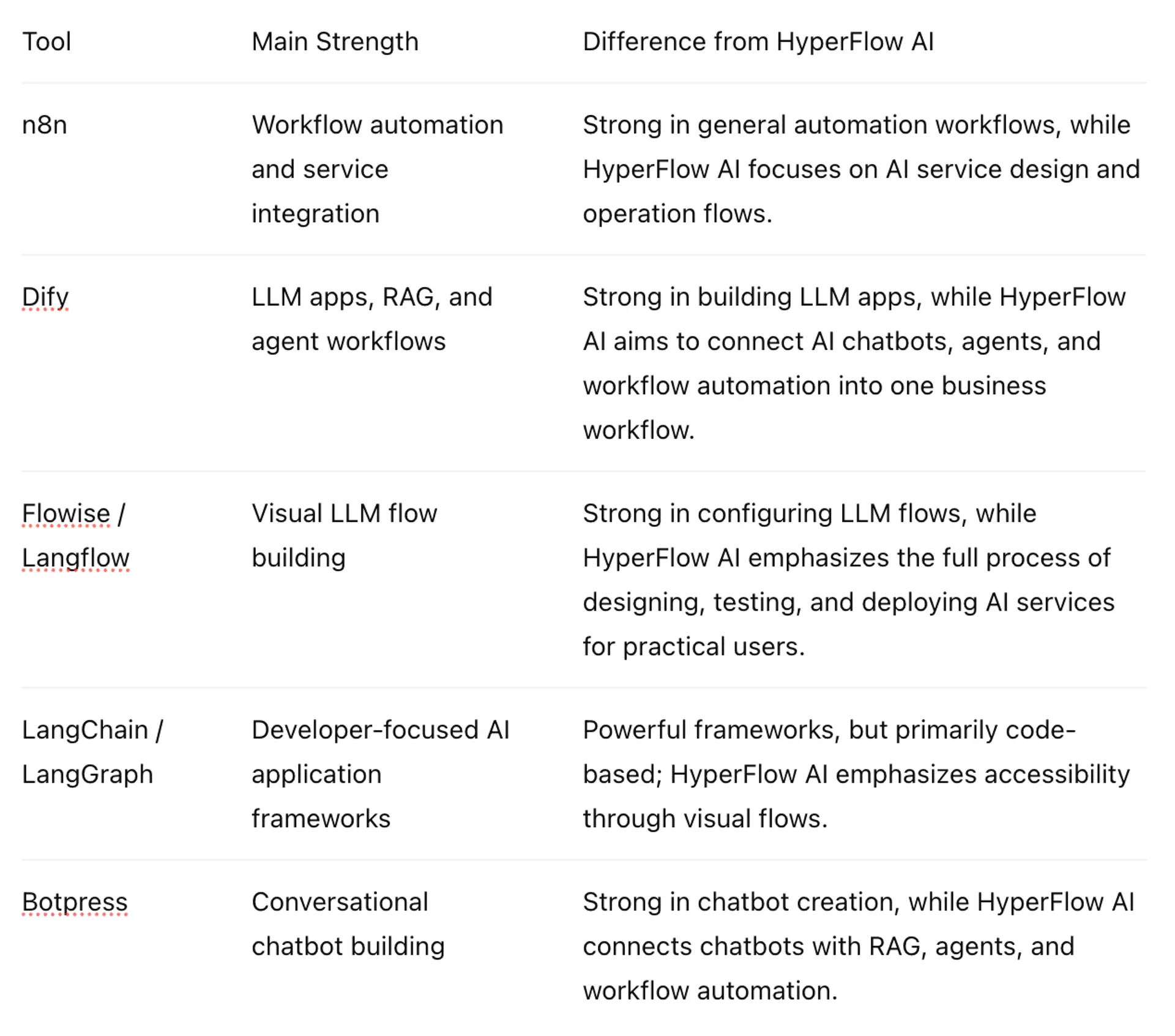
HyperFlow AI’s differentiation is not that it provides only one specific function. It connects the process of building and operating AI services into one visual workflow, allowing both non-developers and developers to design AI services together and apply them to real work.
How Does HyperFlow AI Solve This Problem?
HyperFlow AI shifts AI development from a code-centered process to a visual workflow-centered process. Users can connect AI functions and business workflows through a drag-and-drop interface without directly writing complex code.
With HyperFlow AI, users can design workflows based on their ideas, connect various AI models such as OpenAI and Google, test the results, and deploy them as web or API services. This makes AI not just a technology handled by developers, but a work tool that business users can configure and operate directly.
The core of HyperFlow AI is not simple automation. It helps users define their own problems and create solution structures using AI.
How HyperFlow AI Lowers the Development Barrier
HyperFlow AI provides the following process so that users can build and operate AI services more easily.
- Users define the business problem or idea they want to solve.
- They build an AI workflow in HyperFlow AI’s visual flow editor.
- They connect the required AI models, data, conditions, and automation flows as nodes.
- They test the configured workflow and review the results.
- They deploy and operate it as a web or API service with a single click.
Through this structure, entrepreneurs can quickly prototype AI services. Educators can create personalized learning tools, and small teams can automate repetitive work to focus on more important tasks. Business professionals can solve the work problems they understand best through AI workflows without relying solely on development resources.
HyperFlow AI’s Core Values
At the center of HyperFlow AI is the belief that technology should not be something people must adapt to; technology should evolve to fit people. This philosophy is reflected across the product design and user experience.
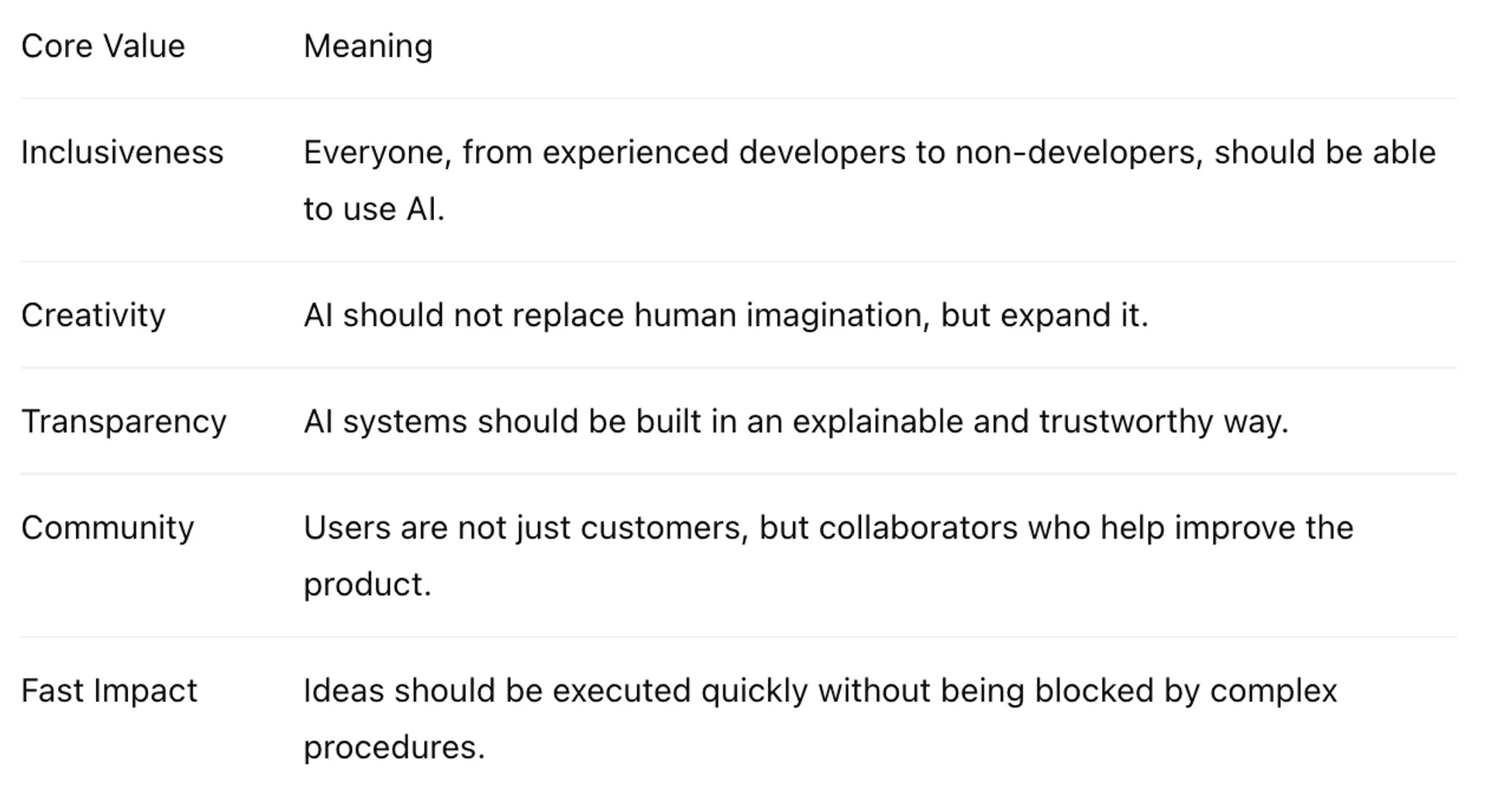
These values show that HyperFlow AI is not simply a feature-based platform, but a platform that aims to change the way AI is used.
What Work Can HyperFlow AI Be Applied To?
HyperFlow AI can be applied to many different work environments.
It can be used for repetitive task automation. Users can build AI workflows for repetitive document processing, customer support, report writing, and data organization.
It can also be used for content creation and marketing. Teams can generate and improve content drafts, landing page copy, social media posts, and email messages based on brand tone.
It can be applied to education and learning design. Teachers and educational institutions can create personalized learning flows based on learner levels.
It is also suitable for internal knowledge management. Organizations can build RAG chatbots or work support agents based on internal documents, manuals, and reports.
It can also be used to quickly prototype new AI services. Entrepreneurs and planners can turn ideas into testable formats without going through complex development processes.
The Future HyperFlow AI Is Building
HyperFlow AI’s long-term vision is to become the world’s most accessible AI platform. To achieve this, HyperFlow AI continues to expand integrations with external services, support more advanced AI models, and improve the product based on user feedback.
The core of the AI revolution is not only the technology itself. What matters is enabling more people to understand AI, use it, and apply it to solve their own problems.
HyperFlow AI aims to make AI not a tool for a small group of experts, but a universal tool placed in everyone’s hands.
Frequently Asked Questions
Q1. What kind of platform is HyperFlow AI?
HyperFlow AI is an AI workflow platform that helps users visually design, test, and deploy AI workflows. Users can build RAG chatbots, AI agents, and workflow automation processes within a single flow.
Q2. What does HyperFlow AI mean by the democratization of AI?
The democratization of AI means making AI not just a technology available to specialists or large enterprises, but a tool that users with different technical backgrounds can use. HyperFlow AI reduces complex development processes so that more people can use AI directly.
Q3. Can non-developers use HyperFlow AI?
Yes. HyperFlow AI provides an intuitive visual flow editor designed to help non-developers build AI workflows. Users can connect AI models and business workflows without directly writing complex code.
Q4. What kinds of organizations is HyperFlow AI suitable for?
HyperFlow AI is suitable for companies that want to apply AI quickly to their work, teams that want to automate repetitive tasks, entrepreneurs who want to experiment with AI services, and educators who want to create personalized learning tools.
Q5. What are HyperFlow AI’s core values?
HyperFlow AI’s core values are inclusiveness, creativity, transparency, community, and fast impact. These values are based on the belief that AI should be open to more people and contribute to solving real user problems.
Conclusion
HyperFlow AI’s mission is to lower the barrier to AI service development and help anyone use AI to solve their own ideas and work-related problems.
When AI becomes a universal tool, the creativity of individuals and organizations can expand more quickly. Based on the philosophy that technology should evolve around people, HyperFlow AI is making AI a practical work tool that everyone can use.